



What Is a Bare Metal Server?
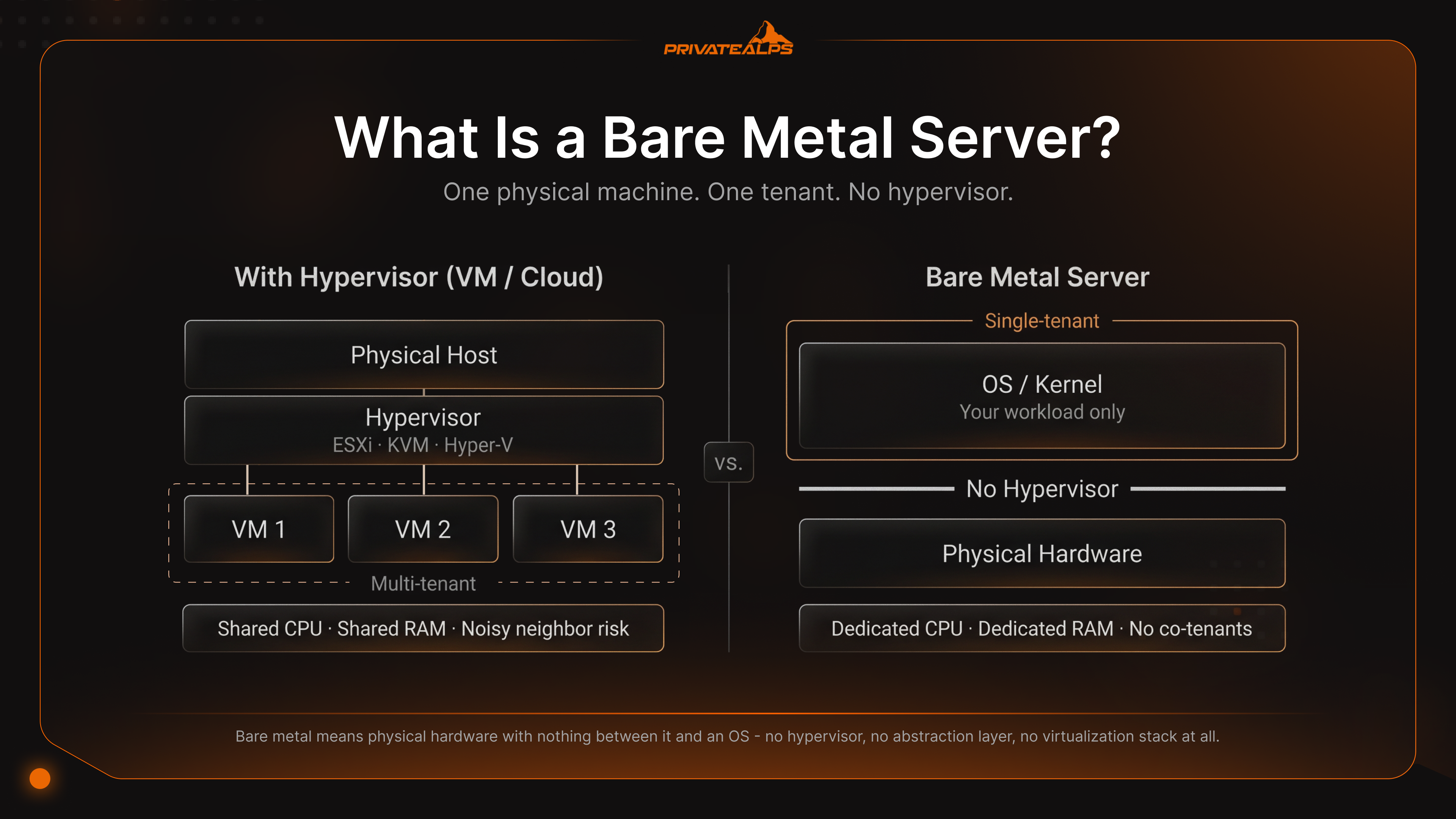
Rent one physical machine. Nobody else gets onto it - no hypervisor between kernel and CPU, no memory pool split across tenants, no virtualization layer doing bookkeeping behind your back. Bare metal servers put an OS directly onto silicon. Kernel registers talk straight to hardware. That's what "bare metal" means.
What are bare metal servers in practice? Single-tenant physical machines - provisioned as traditional dedicated hardware, or through a cloud API - that second approach has its own name, BMaaS. This guide covers how they work, when the tradeoff makes sense, and what's worth checking before choosing a provider.
AI Summary
Bare metal servers give clients exclusive access to all hardware - CPU, RAM, storage, network - with no hypervisor layer and no co-tenants sharing resources.
Key facts:
- No hypervisor overhead: every CPU cycle goes to the workload, not to a virtualization layer managing it
- No noisy neighbor: nobody else competes for I/O, memory bandwidth, CPU time
- Full kernel control: install any OS, tune kernel parameters, load modules unavailable in VMs
- Modern BMaaS provisioning via API takes minutes, not the 24-72 hours of legacy dedicated hosting
- Right fit for HPC, high-load databases, GPU/ML training, fintech, compliance workloads
- Higher entry cost than VMs, but cheaper than equivalent cloud instances at sustained utilization above ~60-70%
- Isolation comes from physical architecture - hardware isn't shared, not a policy choice
- Available as Bare Metal as a Service (BMaaS) with hourly billing and full API automation
:::
What Does Bare Metal Mean?
"Bare metal" means physical hardware with nothing between it and an OS - no hypervisor, no abstraction layer, no virtualization stack at all. Programmers used the phrase before hosting companies picked it up. Running with dedicated hardware meant code executing straight on hardware registers. No OS underneath. No runtime. Nothing intercepting calls.
In server terms, what is baremetal comes down to one missing thing: no hypervisor pre-installed. No VMware ESXi, no Hyper-V, no KVM sitting between kernel and CPU. Why does that matter? NIST SP 800-145 puts it plainly - virtualization makes cloud multi-tenancy possible. Pull it out and multi-tenancy stops working architecturally.
What actually arrives at hardware level: specific processor - AMD EPYC 9004 series, Intel Xeon Scalable 4th/5th Gen. Real ECC DDR5 memory. NVMe or enterprise SSD wired directly to PCIe lanes, not sitting behind storage abstraction. Physical NIC with dedicated uplink, usually between 1 Gbps and 100 Gbps. Nothing emulated. No memory bus shared with a stranger's batch job, no CPU scheduler splitting time between tenants, no I/O queue backed up behind someone else's database flush.
How Does a Bare Metal Server Work?
What does bare metal server mean at a process level? Machine boots over the network, OS lands on local storage, root access changes hands. Provider keeps the physical machine. Everything above the kernel belongs to whoever provisioned it.
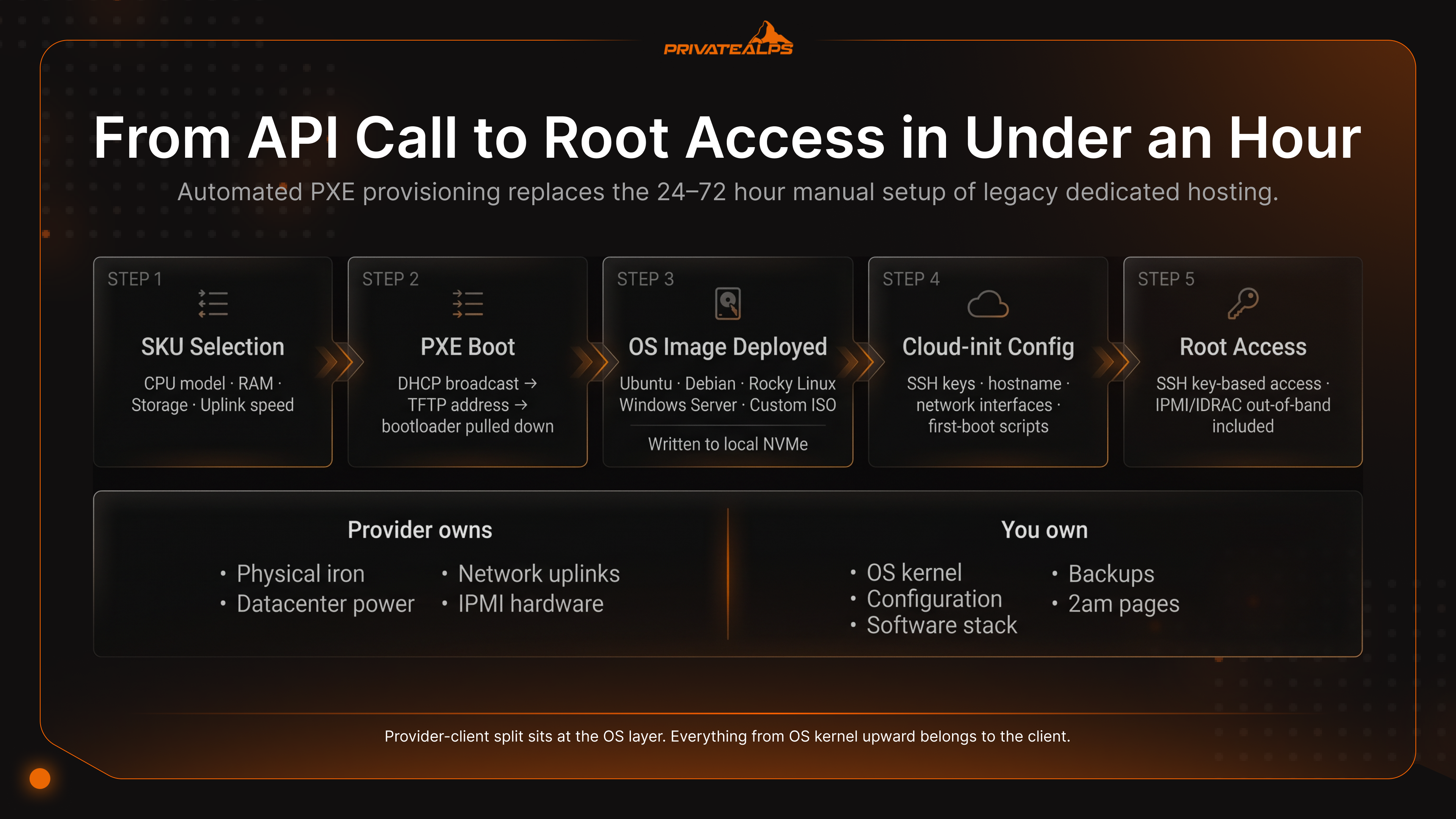
Here's how provisioning actually goes:
- Hardware selection and allocation - Pick SKU - CPU model, RAM, storage type, uplink speed. Provider pulls physical machine from inventory, assigns it exclusively.
- Network boot (PXE) - Server boots via Preboot Execution Environment. PXE client sends a DHCP broadcast, gets a TFTP address back, pulls down a bootloader. Standard stuff.
- OS image deployment - Chosen image - Ubuntu, Debian, Rocky Linux, Windows Server, FreeBSD, custom ISO - gets written to local NVMe or SSD over the network. Partition layout, GRUB or systemd-boot installation, all handled here.
- Post-install config - Cloud-init drops in SSH keys, sets hostname, wires up interfaces, runs first-boot scripts.
- Reboot to disk - Server comes up with freshly installed OS. PXE gone from boot order.
- Root access handed over - SSH credentials or key-based access. IPMI/iDRAC out-of-band comes separately - hardware-level control that keeps working even when OS goes down.
Provider-client split sits at OS layer. Provider covers physical iron, datacenter power and cooling, network uplinks, IPMI. Everything from OS kernel upward - configuration, hardening, software stack, backups - belongs to the client. That's a different contract than managed hosting, where someone else still runs the OS layer. Worth knowing before being the one getting paged at 2am.
Bare Metal vs. Virtual Machine: Key Differences
Not different rungs of the same ladder. Dedicated physical machines and virtual machines represent different isolation models, different cost curves, different failure modes. Most of these infrastructure decisions also involve a third option - public cloud instances - so any honest comparison needs all three columns.
| Dimension | Bare Metal Server | Self-Hosted VM / VPS | Public Cloud Instance (AWS EC2, GCP, Azure) |
|---|---|---|---|
| Isolation | Physical (single tenant) | Logical (hypervisor-enforced) | Logical (shared multi-tenant host) |
| CPU | All cores dedicated, no scheduler overhead | vCPUs share physical cores | vCPUs time-shared; "credit" limits on burstable types |
| RAM | All physical RAM dedicated | Fixed allocation from host RAM | Fixed allocation; NUMA topology opaque to client |
| Disk I/O | Direct NVMe/SSD PCIe access | Emulated or paravirtualized I/O | Network-attached block storage (EBS, Persistent Disk) with variable latency |
| Network I/O | Dedicated physical NIC | Shared NIC via SR-IOV or software bridge | Shared host NIC; throughput capped by instance tier |
| Provisioning time | Minutes (BMaaS) to hours (legacy) | Seconds to minutes | Seconds |
| Scalability | Manual; requires new server | Fast horizontal scaling | Near-instant horizontal and vertical scaling |
| Cost model | Monthly or hourly (BMaaS) | Hourly or monthly | On-demand, reserved, or spot pricing |
| Noisy neighbor risk | None - no co-tenants | Low (hypervisor limits) | Moderate - shared physical host |
| OS/kernel control | Full - any kernel, any module | Limited by hypervisor and host kernel | Limited; some instance types restrict kernel versions |
| Best for | HPC, databases, GPU training, compliance | Dev/test, low-traffic apps, variable workloads | Burst traffic, variable demand, managed services |
The noisy neighbor problem is worth understanding concretely. One tenant running something memory-hungry, or firing off a fat I/O burst, saturates the memory bus - L3 cache fills, network queue backs up. Everyone else eats the latency even if their own workload sits idle. Hypervisors try throttling through CPU scheduling, but memory bandwidth doesn't partition cleanly and PCIe bus contention stays genuinely hard to contain. Single-tenant hardware has no co-tenants. Problem structurally ceases to exist.
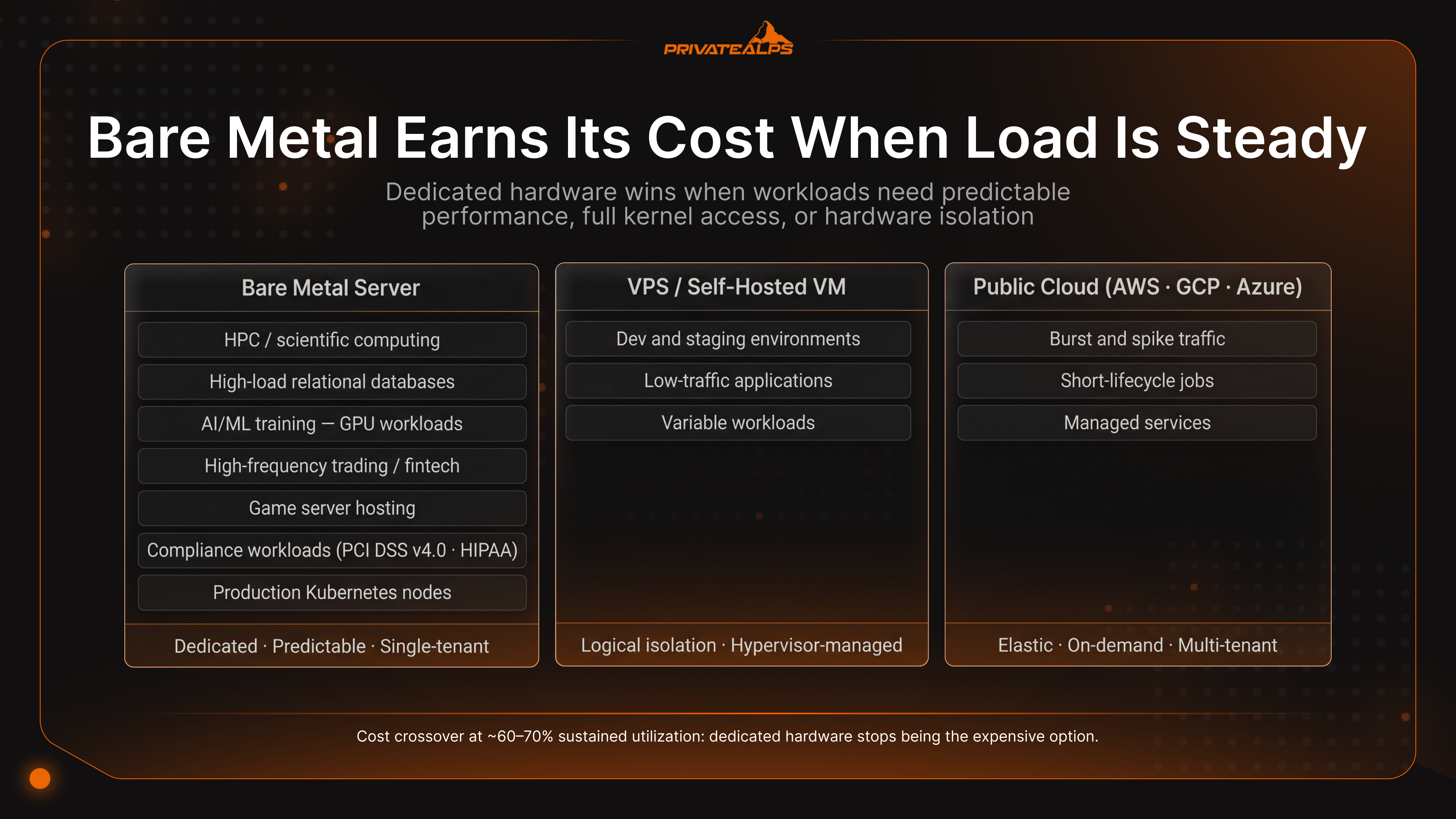
Cost crossover: somewhere around 60-70% sustained utilization, dedicated hardware stops being the expensive option. Cloud VM at $0.50/hr running 24/7 costs $4,320/year. Same compute profile runs $150-200/month on dedicated hardware - $1,800-2,400/year. Call it 45-58% less at constant load. Cloud wins when utilization stays choppy, when workloads average 20-30% and billing runs only against active hours. Once load steadies, fixed pricing starts winning the math.
What Is a Bare Metal Hypervisor?
A bare metal hypervisor - Type 1 - is virtualization software that installs directly onto physical hardware, not on top of an existing OS. Despite sharing two words, it has nothing to do with dedicated single-tenant servers. One enables virtualization. The other eliminates it.
Type 1 hypervisors - VMware ESXi, Microsoft Hyper-V, KVM (baked into the Linux kernel) - run straight on hardware. Hypervisor itself is the base layer; VMs live on top. Type 2 - VirtualBox, VMware Workstation, Parallels - install onto existing OS and borrow its hardware access. That extra OS layer underneath makes Type 2 reasonable for a developer's laptop, poor fit for production.
Mix-up between these two terms happens often enough to spell out directly. They're opposites. Bare metal hypervisor creates and manages virtual machines, giving them controlled hardware access. Dedicated servers have no hypervisor at all. Put ESXi onto a box and it becomes a virtualization host - exactly the opposite.
| Type | Installed On | Examples | Overhead |
|---|---|---|---|
| Type 1 (Bare Metal Hypervisor) | Directly on hardware | VMware ESXi, Hyper-V, KVM | Low (3-8% CPU, minimal RAM) |
| Type 2 (Hosted Hypervisor) | On top of a host OS | VirtualBox, VMware Workstation | High (host OS + hypervisor layers) |
| No Hypervisor | N/A | Bare Metal Server | None |
Bare Metal Server vs. Dedicated Server: Is There a Difference?
Both mean single-tenant physical hardware. What changed is delivery model - API and hourly billing versus a phone call, a setup fee, and waiting two days for someone to rack the machine.
"Dedicated server" was standard hosting vocabulary by the early 2000s. Physical machine, provisioned manually, typically locked into a 30-to-90-day contract with setup fee. Hardware generations were mixed - whatever happened to be in the rack. Automation near zero. Provisioning taking 48 hours was normal.
Understanding what is bare metal server in the current sense means understanding what shifted. IBM SoftLayer - now IBM Cloud - was among the first providers to wrap physical hardware in a cloud API. OVHcloud and Equinix Metal followed. All of it - automated PXE provisioning, hourly billing, cloud networking - rolled together. Hardware caught up too: current offerings mean Intel Xeon 4th/5th Gen or AMD EPYC 4th Gen, NVMe as standard baseline, 25-100 Gbps uplinks. Not legacy gear collecting dust somewhere.
| Parameter | Dedicated Server (Traditional) | Bare Metal Server (Cloud Model) |
|---|---|---|
| Provisioning time | 24-72 hours (manual) | Minutes to 2 hours (automated PXE) |
| Billing model | Monthly or annual, setup fee | Hourly or monthly, no setup fee |
| Hardware generation | Often mixed/legacy | Current-generation CPUs and NVMe |
| API/automation | None or limited | Full API, Terraform/Ansible support |
| OS deployment | Provider-selected or manual | Self-service from OS catalogue or custom ISO |
| Typical provider type | Traditional hosting companies | Cloud and hybrid infrastructure providers |
Half the providers out there use both terms for the same product. Question that actually matters: can servers be provisioned through an API under an hour, or does someone file a ticket and wait?
What Is Bare Metal as a Service (BMaaS)?
Bare Metal as a Service (BMaaS) is a delivery model, not a product type - physical servers through an API, billed by the hour, no multi-tenancy. That's the whole definition.
Difference from traditional dedicated hosting shows up immediately. No ticket sitting in a queue. No contract negotiation. No waiting for someone to physically cable machines. Call the API, pick SKU and OS, and you get root access within the hour. Terraform and Pulumi work just like they do against cloud instances. That makes dedicated hardware practical now for workloads that used to be too short-lived - CI/CD nodes needing burst compute for a few hours, ML training jobs wanting a full GPU cluster over a weekend, HPC batches spinning up quarterly then disappearing.
Regulated industries land here for different reasons than performance teams. PCI DSS v4.0 requires isolation of cardholder environments - bare metal servers satisfy this at architecture level, not by stacking compensating controls. HIPAA needs physical and technical safeguards for PHI; single-tenant hardware with documented destruction policies handles both. GDPR and residency rules add another layer: datacenter location isn't just about milliseconds anymore. It determines which legal framework governs stored data. Providers in non-EU jurisdictions with adequacy decisions - Switzerland under the revDSG is the clearest example - let organizations stay GDPR-compliant without keeping data inside EU borders.
Managed bare metal is one step further. Provider takes for OS-level operations - patching, security updates, monitoring - sometimes more. If a team wants dedicated hardware performance but nobody signed up to own the OS layer at 2am, that managed tier is the answer. Less kernel-level flexibility. Fewer pages during nights and weekends.
Key Use Cases for Bare Metal Servers
Dedicated servers earn their cost when workloads need predictable performance under sustained load, full kernel access, or hardware isolation a hypervisor boundary can't genuinely provide. Variable and short-lived compute belongs somewhere else.
| Use Case | Why Bare Metal | Concrete Example |
|---|---|---|
| HPC / scientific computing | No hypervisor scheduling jitter; full memory bandwidth; MPI over RDMA requires low-latency physical NICs | Computational fluid dynamics simulations, genomics pipelines |
| High-load relational databases | Direct NVMe I/O without storage virtualization; predictable latency under concurrent write load | PostgreSQL or Oracle DB at 10K+ TPS; MySQL clusters for financial records |
| AI/ML training (GPU workloads) | GPU passthrough required for full performance; shared vGPU adds 15-30% overhead vs. direct access | Multi-GPU training on NVIDIA H100/A100 for LLM fine-tuning |
| High-frequency trading / fintech | Sub-millisecond latency; kernel bypass networking (DPDK, RDMA) requires direct hardware access | Algorithmic trading engines needing deterministic tick-to-trade latency |
| Game server hosting | Consistent frame timing; low-latency NIC for UDP game traffic | Dedicated servers for competitive multiplayer titles |
| Compliance workloads | Physical isolation satisfies PCI DSS v4.0 and HIPAA technical safeguards without compensating controls | Payment processing, healthcare record systems |
| Production Kubernetes nodes | No hypervisor CPU overhead for node agents; better pod density and I/O throughput | Kubernetes worker nodes running stateful workloads with local PV |
Wrong call: workloads with unpredictable spikes belong through cloud autoscaling - bare metal servers don't scale fast enough. Dev and staging almost never justify dedicated iron; VPS or spot instance gets the job done cheaper. Short-lifecycle jobs - batch runs under 30 minutes, CI/CD unit tests - get penalized by BMaaS startup time at that timescale. And if nobody wants to own OS patching, hardware monitoring, failure response, a managed plan is just the more honest choice.
Bare Metal Server Security
Single-tenant physical servers remove two attack categories that structurally require multi-tenancy. Everything above the hardware layer remains entirely the client's responsibility.
Security benefit here runs architectural - real but bounded. Two threat classes are present specifically within shared virtualized infrastructure - and both are worth naming. VM escape bugs, where a hypervisor vulnerability lets a guest VM run code outside its boundary or read adjacent VM memory - VENOM (CVE-2015-3456) and a long trail of QEMU/KVM CVEs are what those look like in practice. Then cross-tenant CPU side-channel attacks: CVE-2018-3646 (L1 Terminal Fault - VMM) lets a malicious VM infer contents from the L1 cache of the hypervisor or a neighboring VM through speculative execution - no boundary escape required.
Spectre and Meltdown use the same mechanics, getting nastier when attacker and victim share physical cores. Remove the hypervisor and co-tenants, both classes have nothing to exploit.
What doesn't change: everything sitting above hardware. SSH at port 22, unpatched kernel running for six months, a firewall rule someone fat-fingered, credentials that got reused - none of that improves just from having a dedicated machine. NIST SP 800-53 Rev. 5 makes the point clearly: real security means access management, configuration management, audit logging, incident response. Hardware model counts as one input - not a substitute for the rest.
What needs to be set up before calling any server production-ready:
- Disable root SSH. Key-based auth only, no exceptions.
nftables/iptableswith default-deny inbound - not optional for your servers, not "later".- Automatic OS security updates enabled (
unattended-upgradeson Debian/Ubuntu). - IPMI/iDRAC on a dedicated management VLAN - your production network should never reach it.
- LUKS full-disk encryption for data at rest - non-negotiable.
- Centralized audit logging, tamper-evident, feeding into a SIEM.
- CIS Benchmark applied to whichever OS your team is running.
- Runtime detection: Wazuh, OSSEC, Falco.
How to Choose a Bare Metal Server Provider
Monthly price makes the wrong starting point to start. What matters: provisioning speed, hardware generation, network guarantees, SLA, out-of-band access, OS options, DDoS coverage, datacenter jurisdiction.
| Criterion | What to Look For | Red Flag |
|---|---|---|
| Provisioning speed | Automated PXE; standard OS images deployed under 30 minutes | "24-48 hours" without API; setup via support ticket |
| Hardware generation | Intel Xeon 4th/5th Gen or AMD EPYC 3rd/4th Gen; NVMe standard | CPU generation unnamed, or clearly older hardware |
| Network uplink | Dedicated unmetered or high-cap port; guaranteed bandwidth, not "up to" | Shared uplinks; no published throughput SLA |
| DDoS protection | On-path scrubbing with stated Gbps capacity and auto-mitigation | No published capacity; "contact support during an attack" |
| Uptime SLA | 99.9% network uptime minimum; hardware replacement SLA documented | No SLA; "best effort" anywhere in terms |
| IPMI/iDRAC access | Out-of-band access included; KVM-over-IP available | No OOB access; hardware control only through running OS |
| OS flexibility | Self-service reinstall from catalogue; custom ISO upload; PXE rescue mode | Fixed OS list; reinstall requires support ticket |
| Jurisdiction / compliance | Documented datacenter location; published legal framework; deletion policy | "Global infrastructure" without country-level specifics |
Jurisdiction gets underestimated until something goes wrong. Under GDPR Article 44, transferring personal data outside the EEA requires an adequacy decision, Standard Contractual Clauses, or equivalent protection. Switzerland has held EU adequacy since 2000.
On 15 January 2024, after European Commission's first GDPR-based review, that status was formally confirmed - the revised Federal Act on Protection of Personal Data (revDSG, September 2023) cited as key factor. For EU-facing workloads where data residency outside EU territory matters, Swiss-jurisdiction infrastructure is a clean answer. For U.S.-regulated operators, question runs differently: which legal instruments - subpoenas, national security letters, warrants - can physically reach server records, under which country's laws. Fintech, healthcare, legal teams usually discover how much this matters later than they should.
Bare Metal Server Pros and Cons
Performance and isolation case runs strong. Cost and flexibility at low utilization genuinely isn't. Which side applies depends almost entirely on how steady your load actually is.
| Pros | Cons |
|---|---|
| Full hardware dedicated to one tenant | Higher monthly cost than VPS or cloud VMs at low utilization |
| No hypervisor overhead - CPU, RAM, I/O at full capacity | Scaling horizontally means ordering another server |
| No noisy neighbor - performance stays predictable under load | OS, patching, monitoring belong to client |
| Full kernel and OS control - any distro, Windows Server, custom kernels | Hardware failure needs physical replacement; speed depends on provider SLA |
| Structural isolation satisfies PCI DSS v4.0, HIPAA, residency requirements | Provisioning is slower than VM spin-up even with automated PXE |
| Dedicated IP, IPMI access, physical NIC - no shared network stack | Not cost-effective at low utilization or burst-only workloads |
Cost math at steady load: take a 32-core workload averaging 80% CPU utilization. AWS EC2 c6i.8xlarge - 32 vCPU, 64 GB RAM - runs approximately $993/month on-demand in us-east-1 ($1.36/hr × 730 hours, roughly $11,916/year). Current-gen bare metal server with similar specs from a European provider costs $200-350/month ($2,400-4,200/year). That's 3-5× less at constant load. Cloud instance wins when average utilization drops to 15-20% - at that point on-demand and spot pricing change the calculation entirely. Crossover runs right through utilization rate, and most teams don't calculate it until well past it.
Summary
One physical machine. One tenant. No hypervisor. Every CPU cycle, every gigabyte of RAM, every I/O operation goes to one workload. None of it shared. Appeal isn't raw benchmark speed - it's that servers behave the same way at 3am Tuesday as during Friday afternoon traffic peaks. Bare Metal as a Service wraps that predictability into a cloud delivery model: API provisioning, hourly billing, root access under an hour instead of 24-72 hours of legacy wait. For workloads needing consistent throughput, full kernel access, or hardware isolation satisfying PCI DSS v4.0 or HIPAA - this is the technically right call. At sustained utilization, usually the cheaper one too.
Ready to Deploy on Dedicated Swiss Infrastructure?
PrivateAlps runs bare metal servers in Switzerland under the revDSG - Swiss protection law that received EU adequacy confirmation in January 2024. Every machine is physically dedicated to one client: no co-tenancy, dedicated IP, full IPMI out-of-band access, documented privacy guarantees.
FAQ
What is a bare metal server in simple terms?
You're renting one whole physical machine. No other customers share your CPU, RAM, storage - no software layer sits between OS and hardware. You get the full performance of the machine, not a slice of it. Think of it as the difference between renting an apartment and renting a room in someone else's house.
What is the difference between a bare metal server and a VPS?
VPS runs as a virtual machine within a shared physical host - hypervisor manages the whole box and carves it up between customers. If one VPS tenant does something CPU-intensive, everyone across that host feels it. Bare metal servers have no hypervisor and no co-tenants at all. All hardware belongs to one client, and what others are doing elsewhere has no path to affect your performance.
What does bare metal mean in cloud computing?
Physical hardware delivered through a cloud model - API provisioning, flexible billing, automated OS deployment - without the virtualization layer that standard cloud instances use. Bare Metal as a Service (BMaaS) is the formal name for that delivery model. Same physical hardware as always, provisioned and billed like cloud.
What is a bare metal hypervisor?
Bare metal hypervisor - Type 1 - is virtualization software that installs directly onto physical hardware, no host OS required. VMware ESXi and Microsoft Hyper-V are the standard examples. Despite sharing the phrase, this type of hypervisor and a dedicated single-tenant server are opposites - one creates virtualization, the other has none.
Is a bare metal server more secure than a VM?
In two specific ways, yes. Cross-tenant CPU side-channel attacks like CVE-2018-3646 (L1 Terminal Fault - VMM, lets a malicious VM infer L1 cache contents from a neighboring VM via speculative execution) and VM escape vulnerabilities that exploit the hypervisor boundary both become structurally irrelevant without a hypervisor and co-tenants. Bare metal does nothing about an unpatched OS, misconfigured firewall, weak credentials. Hardware model is one factor. Configuration and maintenance are the rest.
When should I use a bare metal server instead of cloud VMs?
When your workloads are stable and consistently heavy, and consistent throughput matters more than elastic scaling - databases, ML training, HPC, fintech, compliance applications. Cloud VMs fit variable demand, short-lifecycle jobs, dev and test. Most serious production setups are running both: dedicated servers for stateful core workloads, cloud VMs for burst and edge capacity.
Can I install any operating system on a bare metal server?
Any OS the hardware supports. Any Linux distro, Windows Server, FreeBSD, custom ISO. PXE boot handles network-based installation. IPMI/iDRAC gives hardware-level access for reinstalls even when your OS itself is broken or missing. Custom kernel modules, PREEMPT_RT real-time patches, DPDK networking stacks - all available with full kernel control.
How long does it take to provision a bare metal server?
With a modern BMaaS provider, 15-60 minutes. Automated PXE boot plus cloud-init handles OS installation, network configuration, your credential delivery without anyone physically touching the server. Traditional dedicated hosting was 24-72 hours, human involved at every step. Difference is automation - same steps, nobody waiting for a ticket to get picked up.