



What Is a Hyperscaler and Why Privacy-Focused Users Are Leaving Them
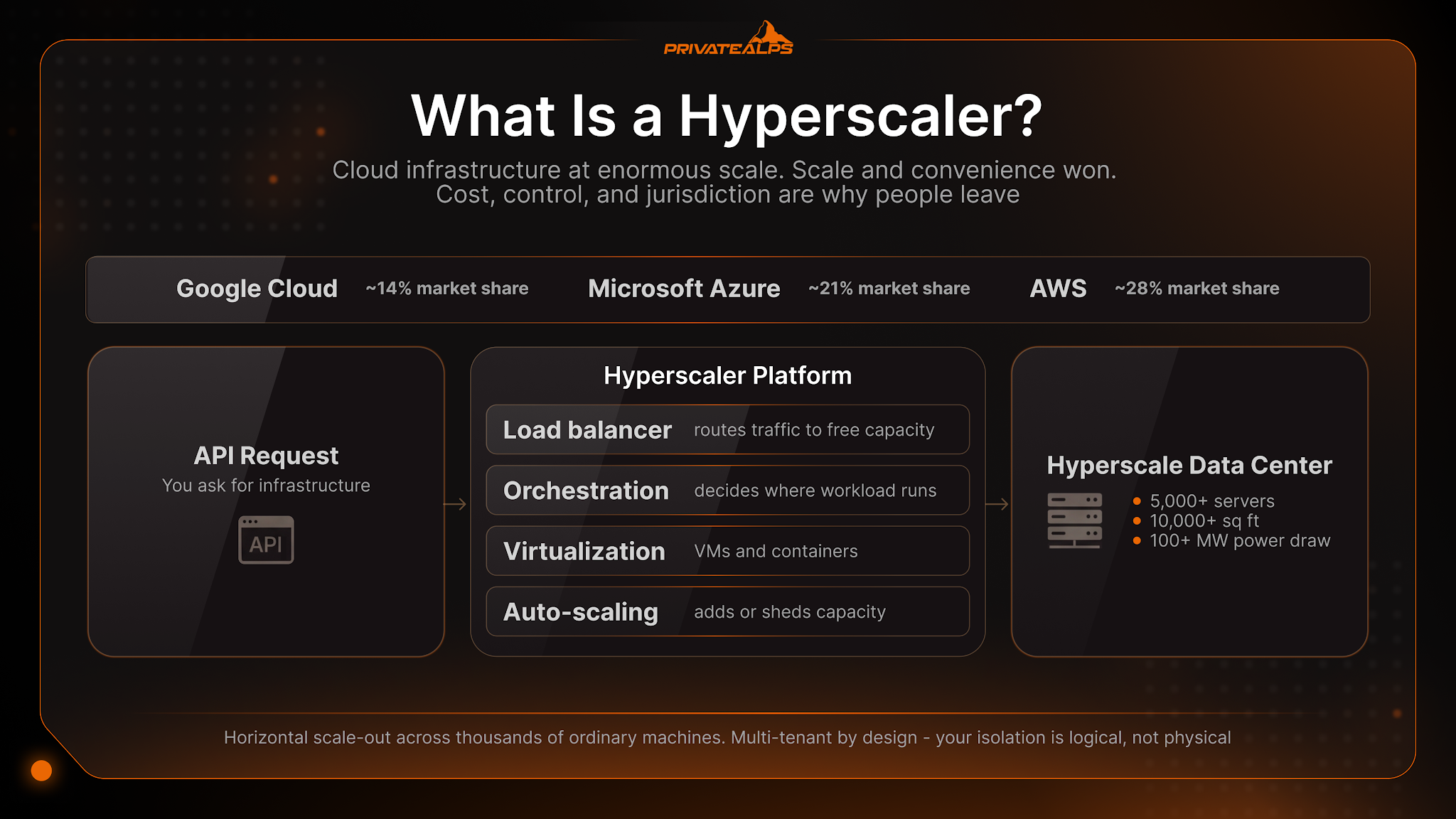
A hyperscaler is a company that runs cloud infrastructure at enormous scale. You're already using three of them, probably without thinking about it: Amazon Web Services (AWS), Microsoft Azure, and Google Cloud. They run sprawling networks of data centers that hand you computing power on demand, for millions of customers at once. In 2025 the hyperscale cloud market cleared $419 billion for the first time, says Synergy Research Group. The big three grabbed most of it.
They won on two things. Scale and convenience. Rent what you need, scale in minutes, never touch a server yourself. If you're running a global app with traffic that jumps around, it's tough to beat.
So who's leaving, and why? A pretty specific crowd. Privacy-focused users. Regulated businesses. Teams that care where their data actually lives. Their reasons aren't really about mood or preference, either. They're structural. Cost. Control. Jurisdiction. The slightly uncomfortable question of who can be made to hand your data over. The rest of this piece works through it: what a hyperscaler is, how hyperscale computing actually works under the hood, who the players are, why people walk, and where they go instead.
In Brief
Short version first, then the bullets. Hyperscalers are the operators behind the world's biggest public clouds, built to scale out across thousands of servers on their own, no hand-holding. That's why they dominate. It's also, oddly enough, part of why a certain kind of user is heading for the door.
- Definition: companies running cloud infrastructure at massive scale (AWS, Azure, Google Cloud).
- Size threshold: IDC classes a facility as hyperscale at 5,000+ servers and 10,000+ sq ft.
- Defining property: horizontal scale-out, not bigger boxes.
- Top business reason to leave: unpredictable cost plus vendor lock-in.
- Top privacy reason to leave: jurisdiction and lawful-access exposure (US CLOUD Act).
- Main alternatives: independent/regional cloud, dedicated bare metal, VPS, sovereign hosting.
- What they still do best: bursty, global, service-rich workloads.
What Is a Hyperscaler?
A hyperscaler is a company that builds and runs cloud computing infrastructure at a scale most data centers never get near, renting out compute, storage, and networking on demand. Trouble is, people use the word loosely. So pinning down the hyperscalers meaning means pulling apart three things that get mashed together: the operator, the building, and the architecture underneath both.
| Term | What It Refers To |
|---|---|
| Hyperscaler | The operator/company that runs the cloud at scale (e.g. AWS, Azure, Google Cloud). |
| Hyperscale data center | The physical facility - servers, power, cooling, networking - where the workloads run. |
| Hyperscale computing | The architecture and practice of scaling capacity out across many machines automatically. |
Where's the cutoff? The IDC hyperscaler definition draws it at 5,000 servers and 10,000 square feet, going by IBM's summary. That's the floor. Nowhere near the ceiling. The actual giants make that number look almost cute. Apple's Mesa site covers 1.3 million square feet. Google's Council Bluffs campus blows past two million. And the thing that makes all of it tick is horizontal scale-out. You don't build one monster machine. You add thousands of ordinary ones and spread the work across them.
How Does Hyperscale Computing Work?
Hyperscale computing works by spreading workloads across thousands of cheap, off-the-shelf servers and scaling out sideways instead of buying bigger boxes. Software does the rest. It hands out, balances, and swaps resources automatically, so capacity grows or shrinks with demand. And all of that machinery hides behind an API, so you ask for infrastructure and it just shows up.
A few layers underneath do the real work. Virtualization (hypervisors, virtual machines, containers) carves physical hardware into pools you can move around. Software-defined networking and orchestration figure out where each job goes. Load balancers swallow the traffic spikes. Redundancy and failover across availability zones keep things running when a server dies, and servers die all the time. Here's the bit worth holding onto, though. It's all multi-tenant. Loads of customers sharing the same physical box, kept apart by logic, not by walls. Remember that one. It's the whole hinge of the privacy argument later.
A typical request moves through the stack like this:
- A user request hits the platform's entry point.
- A load balancer routes it to free capacity.
- The orchestration layer decides where the workload should run.
- A VM or container gets spun up to handle it.
- Compute and storage do the work and save the result.
- Auto-scaling adds or sheds capacity as demand shifts.
And none of this is cheap to power. Hyperscale infrastructure routinely draws north of 100 megawatts a site, which is exactly why these things now get planted wherever electricity is cheap and there's plenty of it.
Hyperscale vs. Traditional Data Centers vs. Colocation
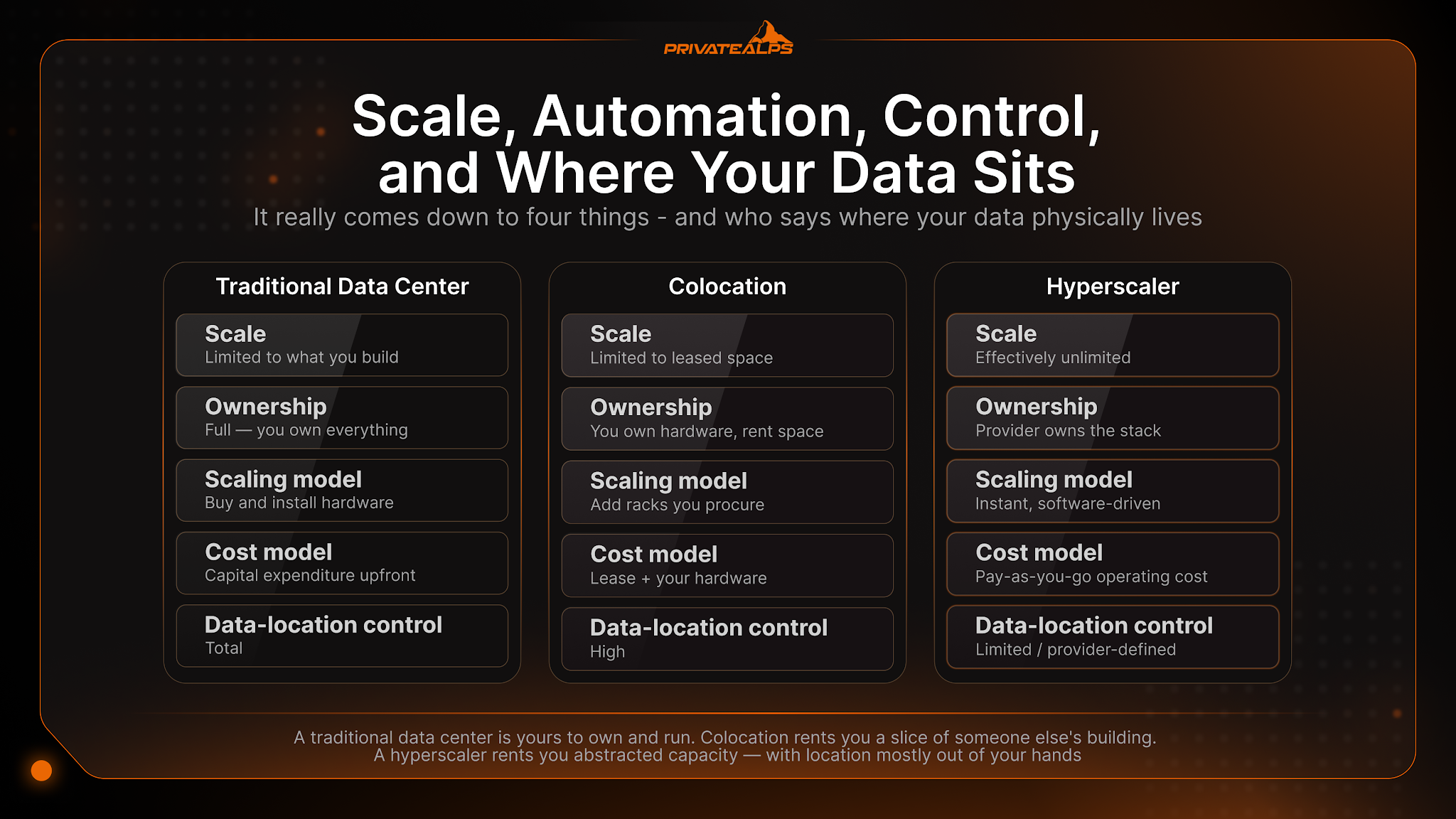
It really comes down to four things. Scale. Automation. Who's stuck carrying the operational load. And who gets to say where your data physically sits. A traditional data center is yours to own and run. Colocation rents you a slice of someone else's building. A hyperscaler rents you abstracted capacity, quick and painless, with location mostly out of your hands.
| Dimension | Traditional Data Center | Colocation | Hyperscaler |
|---|---|---|---|
| Scale | Limited to what you build | Limited to leased space | Effectively unlimited |
| Ownership & control | Full - you own everything | You own hardware, rent space | Provider owns the stack |
| Scaling model | Buy and install hardware | Add racks you procure | Instant, software-driven |
| Cost model | Capital expenditure upfront | Lease + your hardware | Pay-as-you-go operating cost |
| Automation | Manual / your tooling | Manual / your tooling | Fully automated |
| Data-location control | Total | High | Limited / provider-defined |
Who Are the Hyperscalers? Leading Providers
A "big three" runs the whole show, sitting on roughly 63% of global cloud infrastructure spending between them. Going by Synergy Research Group's Q1 2026 numbers, AWS is out front at 28%, Azure's next at 21%, and Google Cloud holds 14%. Past those three it gets murky. Alibaba, Oracle, and IBM keep trading spots depending on who's counting, and where.
| Provider | Market Position | Core Strength | Notable Trade-off |
|---|---|---|---|
| Amazon Web Services (AWS) | #1, ~28% share | Broadest service catalog, mature ecosystem | Complex pricing; steep egress fees |
| Microsoft Azure | #2, ~21% share | Deep enterprise and Microsoft 365 integration | Lock-in via bundled licensing |
| Google Cloud | #3, ~14% share | Strongest data, AI/ML, and analytics tooling | Smaller footprint; fewer regions |
| Alibaba Cloud | Leading in Asia-Pacific | Dominance in China and regional reach | Jurisdiction and access concerns abroad |
| Oracle Cloud (OCI) | Rising challenger | Database workloads, aggressive pricing | Narrower general-purpose ecosystem |
Read that last column again. Complex billing. Egress charges. Lock-in. Those aren't fine print. That's the exact stuff that kicks off the "wait, why are we still paying for this" conversation.
What Are Hyperscalers Used For?
Hyperscalers earn their money on workloads that have to scale fast, go global, or lean on a big menu of managed services. They're great when demand is spiky and a team would honestly rather rent a capability than build it and then babysit it forever. Knowing where hyperscale genuinely fits is what keeps the "why leave" argument honest.
- Global consumer apps with bursty, unpredictable traffic.
- Hyperscale data processing and big-data analytics.
- AI/ML model training and inference at scale.
- Large multi-region SaaS platforms.
- IoT data ingestion from millions of devices.
- Disaster recovery and content delivery (CDN) footprints.
- Rapid experimentation, where speed beats cost control.
Benefits of Hyperscalers
They became the default for solid reasons. Near-instant scale. A low-latency footprint that wraps the planet. Operations someone else runs for you. And a pay-as-you-go model that turns a big upfront purchase into a monthly line item. If speed matters to you more than control, it's usually a fair deal.
- Elastic scale on demand - add or shed capacity in minutes.
- Global reach - dozens of regions for low-latency delivery.
- Managed operations - the provider runs the hardware, patching, and uptime.
- Deep service ecosystems - databases, AI, analytics, and security, ready-made.
- Flexible pricing - pay-as-you-go, with reserved instances and volume commits for steadier costs.
Why Businesses Are Leaving Hyperscaler
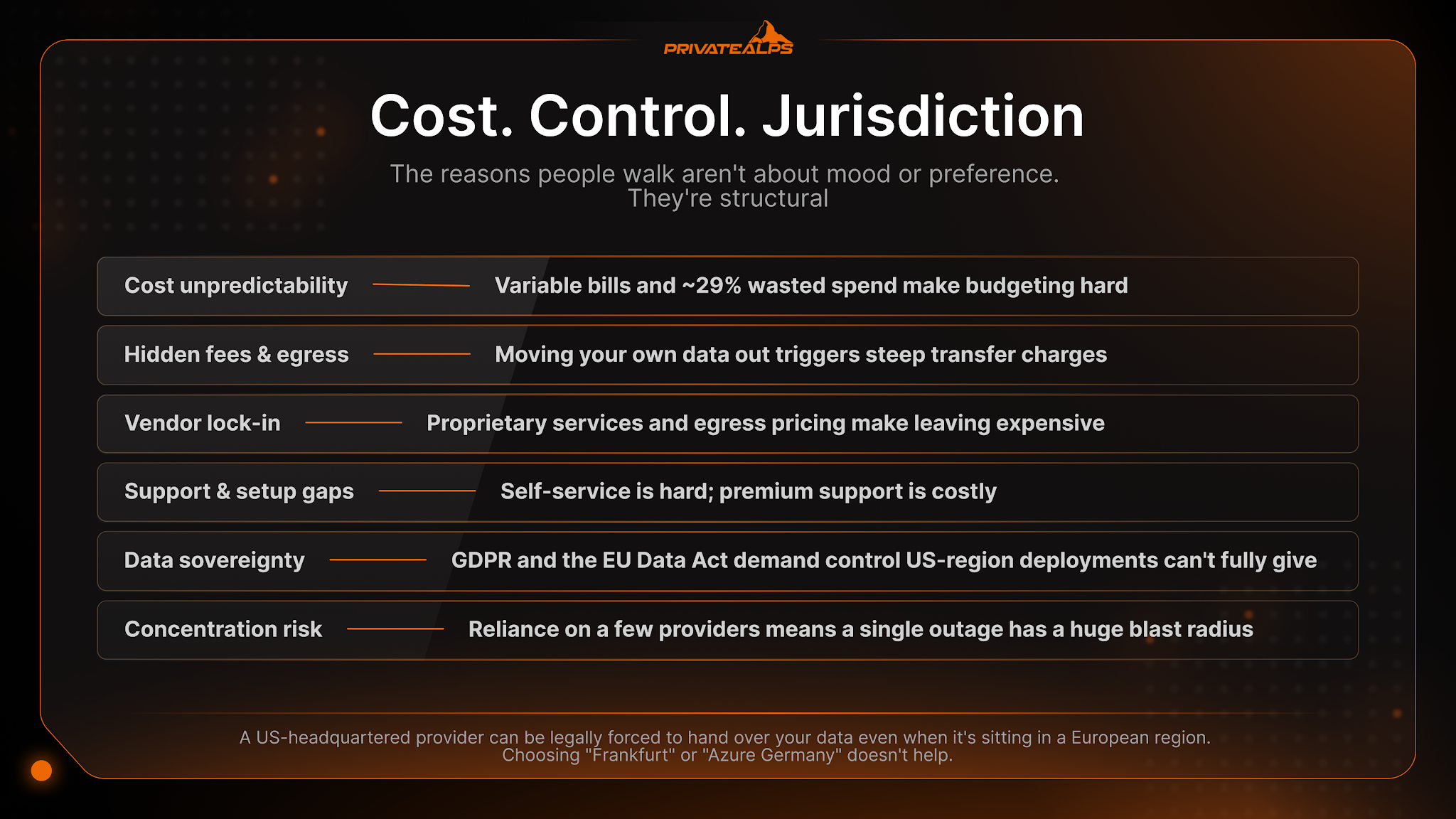
People leave once the financial, operational, and strategic costs of all that scale start to outweigh the convenience. Bills you can't forecast. Lock-in that's very real. And not much say over where your data ends up. Flexera's State of the Cloud report puts wasted cloud spend around 29% in its latest run, with budgets overshot by roughly 17%.
| Reason | What It Means in Practice | Who It Hits Hardest |
|---|---|---|
| Cost unpredictability | Variable bills and ~29% wasted spend make budgeting hard (Flexera). | Finance teams, fast-growing startups |
| Hidden fees & egress | Moving your own data out triggers steep transfer charges. | Data-heavy and multi-cloud teams |
| Vendor lock-in | Proprietary services and egress pricing make leaving expensive. | Enterprises with deep integrations |
| Support & setup gaps | Self-service is hard; premium support is costly. | SMBs and lean teams |
| Data sovereignty | GDPR and the EU Data Act demand control US-region deployments can't fully give. | Regulated and EU-based businesses |
| Concentration risk | Reliance on a few providers means a single outage has a huge blast radius. | Critical-infrastructure operators |
The loudest example is the "cloud exit" crowd. Take 37signals, the people behind Basecamp and HEY. They were looking at a cloud bill north of $3.2 million a year. So they hauled their workloads back onto hardware they own and, per The Register, reckon they'll pocket more than $10 million over five years. The part that stings for AWS: a roughly $1.5-million-a-year S3 bill, swapped out for on-prem storage that runs under $200,000.
The Privacy Problem with Hyperscalers
With hyperscalers, the privacy problem is baked in. It's structural. It lives in the business model and the law, not in some bug waiting to be patched. A US-headquartered provider can be legally forced to hand over your data even when it's sitting in a European region. That, more than anything else, is what makes privacy-focused users walk.
The lever here is the US CLOUD Act. It rewired the Stored Communications Act so any provider under US jurisdiction has to cough up data in its "possession, custody, or control," wherever on earth that data physically lives, per the Congressional Research Service. Choosing "Frankfurt" or "Azure Germany"? Doesn't help. And it rubs hard against GDPR, ever since the Schrems II ruling tore down the old Privacy Shield framework (its replacement, the EU-US Data Privacy Framework, is already getting challenged in court). The hinge is corporate control, not geography. One nuance worth flagging, though: a provider that operates fully outside the US is generally beyond Washington's reach to begin with.
Then there's multi-tenancy, and the data itself. Sharing infrastructure means your isolation is logical, not physical. And the whole hyperscaler model leans on aggregated telemetry, analytics, and metadata, all pooled up with a handful of operators. So the contrast is pretty blunt. Single-tenant dedicated hardware. A no-logs policy you can actually check. Full disk encryption. Together those strip out the provider-access and shared-box variables a multi-tenant hyperscaler just can't get rid of. None of this is about ducking lawful process, to be clear. It's about not handing over more than you have to.
Hyperscaler Alternatives
Honest answer? Every alternative trades a bit of convenience for more control, steadier costs, and firmer ground under your feet legally. None of them is a magic drop-in for every workload. What actually fits depends on what you're running, and on what's actually keeping you up at night.
| Alternative | Best For | Control & Privacy Gain | Trade-off |
|---|---|---|---|
| Independent / regional cloud | Niche, regional, or sovereignty-specific needs | Local jurisdiction, clearer billing | Fewer managed services |
| Multi-cloud / hybrid | Enterprises avoiding single-vendor risk | Resilience, negotiating leverage | Higher operational complexity |
| Dedicated bare metal | Steady, performance-heavy workloads | Single-tenant isolation, no noisy neighbors | You manage more of the stack |
| VPS | Smaller predictable workloads | Cost control, isolation from shared apps | Less raw power than bare metal |
| Dedicated GPU servers | AI/ML training, big-data, high-bandwidth | Private compute for sensitive models | Capacity planning is on you |
| Sovereign / Swiss hosting | Privacy- and jurisdiction-critical data | Outside US CLOUD Act reach | Smaller global footprint |
How to Choose a Hyperscaler Alternative
Judge these on control, jurisdiction, and cost transparency. Not the sticker price. Because the cheapest option that quietly rebuilds your lock-in, or your jurisdiction problem, isn't cheap at all. Run any candidate through a quick checklist before you sign anything.
| Criterion | Why It Matters | Red Flag |
|---|---|---|
| Governing law | Determines who can compel disclosure of your data. | Provider under US jurisdiction for sensitive data |
| Data-residency guarantees | Confirms where data physically lives and stays. | Vague or shifting region commitments |
| Billing transparency | Prevents surprise egress and overage charges. | No clear egress or exit pricing |
| Security & shared responsibility | Clarifies what the provider secures vs. you. | Undefined responsibility boundaries |
| Support & SLA | Determines real uptime and response quality. | Premium-only support, weak SLA |
| Exit & portability | Lets you leave without the next lock-in. | Proprietary formats, costly data export |
When You Still Need a Hyperscaler
Sometimes a hyperscaler is just the right call. Need dozens of regions by tomorrow, deep managed AI services, or elastic capacity for traffic nobody can predict? Then hyperscale is genuinely hard to beat. The point was never to swear them off on principle, it's to match the tool to the job and to your threat model: steady or sovereignty-bound work usually does better elsewhere, while global and bursty work usually doesn't.
Summary
So, to land it: a hyperscaler is a company running cloud infrastructure at massive scale, and that scale is exactly what made AWS, Azure, and Google Cloud the obvious default. But unpredictable cost, vendor lock-in, and sovereignty worries are quietly pushing a specific audience out the door, and privacy-focused users go for an even blunter reason, that a US provider can be made to hand over data no matter where it's parked. The whole trust model flips the moment you own or control the infrastructure yourself instead of renting it from a US hyperscaler.
Thinking about getting off the hyperscaler treadmill? That's pretty much what PrivateAlps is for. Swiss, privacy-first hosting on single-tenant dedicated bare-metal and VPS, with a no-logs policy and full disk encryption that take the multi-tenancy, telemetry, and shared-responsibility baggage off your plate, plus dedicated GPU servers for the AI/ML and high-bandwidth work you'd otherwise ship to a hyperscaler. Swiss jurisdiction sits outside US CLOUD Act reach. To be straight with you, though: Swiss law still allows targeted, court-ordered disclosure under the BÜPF framework, so it's a narrower, court-gated standard than the US or EU bulk-retention regimes, not blanket immunity. Explore privacy-first Swiss hosting at PrivateAlps.
FAQs
What is a hyperscaler in simple terms?
A hyperscaler's just a company running cloud computing at enormous scale, renting out servers, storage, and networking on demand. The obvious names are AWS, Microsoft Azure, and Google Cloud. Between them, they quietly power a big chunk of the apps you open every day.
What is the difference between hyperscale and the cloud?
So what is hyperscale? It's the scale and the architecture behind the biggest providers, whereas "the cloud" is the service model, renting computing over the internet. Put it this way: every hyperscaler offers cloud services, but plenty of cloud providers never run at hyperscale.
How many servers does a hyperscale data center have?
By the IDC definition, you need at least 5,000 servers and 10,000 square feet to qualify. Reality runs way past that, though. Flagship sites cram hundreds of thousands, sometimes millions, of servers onto a single campus.
Who are the biggest hyperscalers?
AWS, Microsoft Azure, and Google Cloud, sitting at roughly 28%, 21%, and 14% of the market in Q1 2026, per Synergy Research Group. Behind them, Alibaba, Oracle, and IBM trail in the low single digits and keep swapping spots by region.
Why are businesses leaving hyperscalers?
Mostly three things: cost they can't predict, vendor lock-in, and barely any say over where data lives. Wasted spend sits near 29% on average (Flexera), and the big cloud-exit stories like 37signals show how much repatriation can claw back. Sovereignty and compliance pressure pile on after that.
Are hyperscalers a privacy risk?
It's structural, not a dig at their security. Under the US CLOUD Act, a US-based provider can be made to hand over data no matter which region it's stored in, and multi-tenant infrastructure means logical isolation, not physical. For anything sensitive, jurisdiction is the deciding factor.
What are the best alternatives to hyperscalers?
Independent or regional cloud, multi-cloud and hybrid setups, dedicated bare-metal servers, VPS, self-hosting, and sovereign hosting, each one matched to a use case. Dedicated GPU and bare-metal boxes handle the AI and high-bandwidth jobs. What fits really comes down to your workload and your threat model.
Does Swiss hosting protect data from the US CLOUD Act?
A Swiss, non-US-owned operator sits outside US CLOUD Act jurisdiction, and once you add a no-logs policy and full disk encryption, there's barely anything left to hand over anyway. That said, Swiss law still allows targeted, court-ordered disclosure under the BÜPF framework, a narrower, court-gated standard, not blanket immunity.
Is self-hosting cheaper than a hyperscaler?
Depends how predictable your workload is. Steady, consistent loads usually win on dedicated or self-hosted gear, and 37signals is the obvious poster child with multi-million-dollar savings. Spiky, unpredictable global traffic might still come out cheaper on a hyperscaler's elastic model.
What is cloud repatriation?
It's moving workloads off a hyperscaler and back onto infrastructure you own, colocate, or run independently, usually for cost or control. Right now it's a documented trend for specific, predictable workloads, not some wholesale rejection of the cloud.