



Web Server vs. Application Server: What's the Difference?
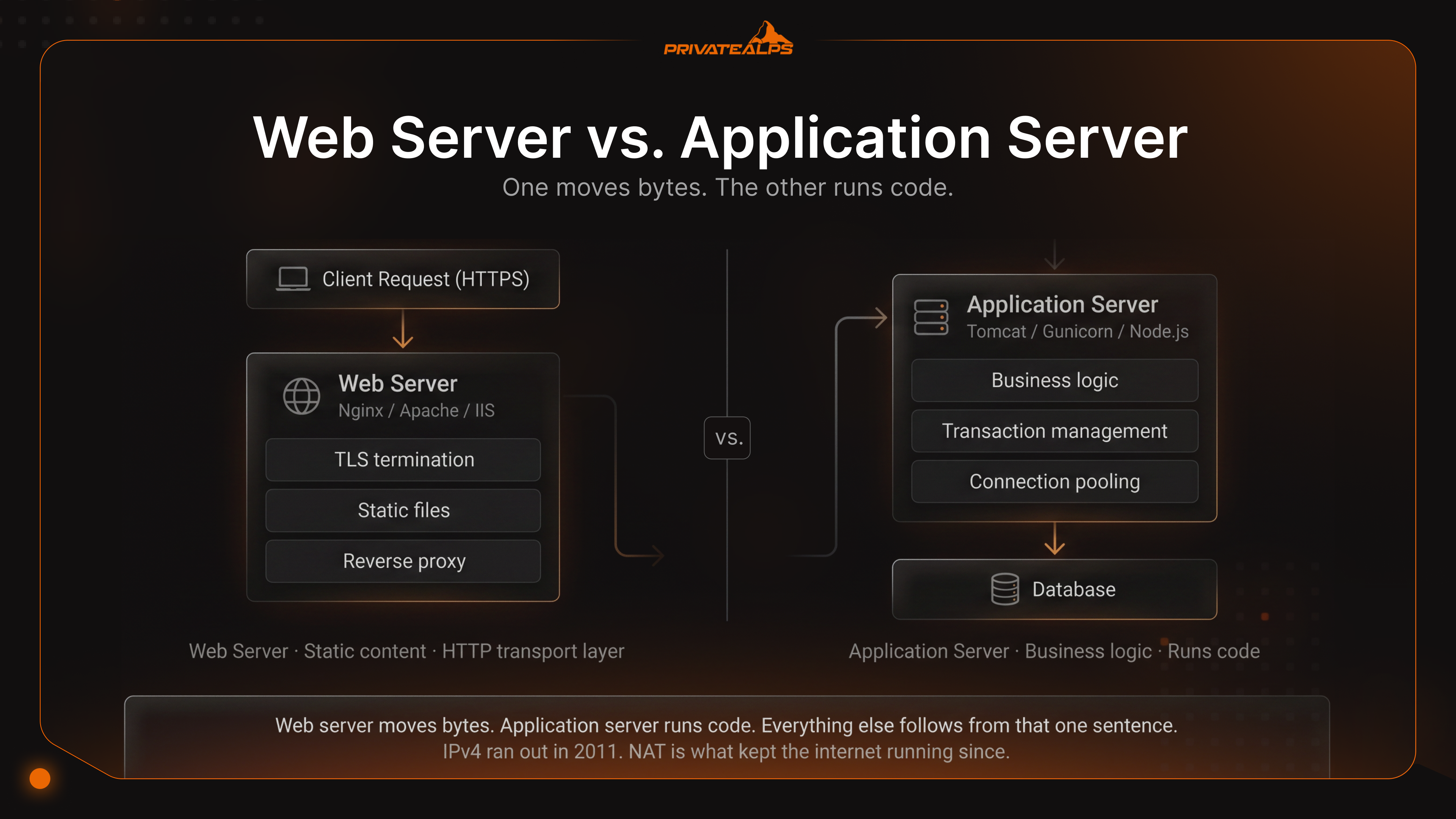
Nobody opens a tab and types "web server vs application server" for fun. You do it because something broke. A checkout that hung. An admin panel that froze when traffic doubled. A pager going off at 2 a.m. because something, somewhere, ran out of threads.
Here's the uncomfortable part. Most "what's the difference" articles read like glossary entries. They list features. They don't tell you when one breaks and the other doesn't. The application server vs web server distinction stops being academic the moment your stack starts doing real work - concurrency, money, sessions, regulated data. That's when the web server vs application server differences start showing up in your monitoring graphs, not before.
This guide is closer to a decision framework than a glossary. By the end you'll know when a single Nginx process is enough, when an application server becomes non-negotiable, and why modern frameworks like Spring Boot and Node.js have blurred the line without erasing it.
AI Summary
A web server delivers static content and proxies HTTP requests; an application server runs business logic, manages transactions, and pools database connections. That's what is web server and application server in one breath. One moves bytes. The other runs code. Web servers live at the HTTP transport layer. Application servers wrap a full language runtime around stateful services. Same machine sometimes, different responsibilities always.
Quick reference, the things worth remembering:
- Static files first - HTML, CSS, images, plain HTTP/HTTPS traffic. That's the web server's home turf.
- Dynamic code lives elsewhere. JVM, Node.js, .NET - pick your runtime; that's where the application server lives.
- Async event-driven I/O on the web server side. Thread-per-request on a lot of application servers, though reactive runtimes are eating into that.
- Transactions, session management, connection pooling - all application server territory, none of it free in a raw web server.
- Real production usually pairs them. Nginx out front, Tomcat (or Gunicorn, or Puma) behind it.
- Spring Boot, Django, Next.js - modern frameworks bundle both layers into one process and call it a day.
- Names you'll see: Nginx, Apache HTTP Server, IIS on the web side; Tomcat, WildFly, WebSphere on the app side.
:::
What Is a Web Server?
A web server is software that takes HTTP/HTTPS requests, pulls static resources off disk, and ships them back. That's the whole job, more or less. Live at the transport edge. Parsing headers, terminating TLS, serving files, forwarding the dynamic stuff upstream. The big names: Nginx, Apache HTTP Server, Microsoft IIS, LiteSpeed, Caddy. Each one has its quirks, but the job description doesn't change much. The difference between web and application server starts here, and it's pretty simple. Web server moves bytes. Application server runs code. Everything else follows from that one sentence.
A typical request walks through these steps:
- Listen. TCP port 80 for HTTP, 443 for HTTPS. Accept the incoming connection.
- Terminate TLS if HTTPS - decrypt the request using the server's certificate.
- Parse the HTTP request line, headers, and body, per RFC 9110.
- Match the URI against virtual host rules, location blocks, and rewrite directives.
- Resolve the response - serve a static file from disk, return a cached object, or hand off to an upstream application server.
- Stream it back, with the appropriate headers (Content-Type, Cache-Control, gzip/brotli compression).
Now, why are modern web servers so weirdly good at concurrency? Async event-driven I/O. Instead of one thread per connection - which gets you killed at scale - Nginx runs a small pool of workers and multiplexes thousands of sockets through epoll on Linux or kqueue on BSD. Boring under the hood. Brutally effective in practice. Per Netcraft's February 2026 Web Server Survey, Nginx held about 22.7% market share across all sites and over 42% across web-facing computers. The configuration syntax isn't winning any beauty contests, but those numbers don't lie.
What Is an Application Server?
An application server is the runtime where your code actually runs - executing business logic, managing transactions, holding session state, handing out the middleware services web servers won't touch. Think container, not server. The thing that wraps your servlets, REST controllers, message-driven beans and gives them somewhere to live. Apache Tomcat. JBoss WildFly. IBM WebSphere. Oracle WebLogic. Payara Server. On the non-Java side, Gunicorn for Python, Puma for Ruby, Node.js with Express. Different ecosystems, same general idea - somewhere to put the code that does work.
A request through an application server typically looks like this:
- Receive the request from a fronting web server, or directly from the client in embedded deployments.
- Authenticate and authorize through the container's security realm or middleware.
- Acquire a database connection from the pool. The application doesn't open a new TCP connection per request - that would be a disaster.
- Begin a transaction if the operation needs atomicity. XA for distributed, local for single-resource.
- Execute business logic - validate input, apply domain rules, call other services.
- Persist or read data through JDBC, JPA, or an ORM.
- Commit or roll back, then return the connection to the pool and serialize the response.
Connection pooling is one of those services that sounds boring until you measure what happens without it. Opening a fresh database connection costs roughly 10–200 milliseconds - TCP handshake, TLS handshake, authentication. Doing that on every request? You've basically launched a denial-of-service attack against yourself. Pools like HikariCP (Spring Boot's default) and Tomcat JDBC keep connections warm and hand them out in microseconds. The Apache Tomcat documentation covers the knobs that actually matter - pool size, validation interval, abandoned connection cleanup.
There's more, though. Session management - sticky sessions, distributed replication through in-memory data grids. Middleware services web servers don't touch - JNDI for resource lookup, JMS for asynchronous messaging, EJB containers for transactional components. This is the stuff that turns "we run a website" into "we process payments and pass an audit." Whether you actually need any of it? Depends on what your site is for. A blog won't. A bank will.
Web Server vs. Application Server: Key Differences
Static vs dynamic - that's the surface answer to the web server vs application server differences. Real one is deeper. Threading models. Protocol stacks. How each one consumes memory under load. The table below covers what to look at when you're capacity-planning or hardening a production stack - the parameters that actually move the needle.
| Parameter | Web Server | Application Server |
|---|---|---|
| Primary function | Serves static content, proxies HTTP requests | Executes business logic, runs application code |
| Content type | HTML, CSS, JS, images, video | Dynamically generated responses, JSON, XML, RPC payloads |
| Protocols | HTTP/1.1, HTTP/2, HTTP/3, WebSocket (proxy) | HTTP plus RMI, IIOP, JMS, gRPC, AMQP, WebSocket (native) |
| Threading model | Async event-driven (Nginx) or hybrid (Apache MPM) | Thread-per-request (Tomcat) or async/reactive (Netty, Vert.x) |
| Transaction support | None | Local and distributed (XA) transactions |
| Connection pooling | None for application data | Built-in JDBC and JCA pools |
| Session management | Stateless by default; sticky sessions via proxy config | Native session context, clustering, replication |
| Security layer | TLS termination, WAF rules, rate limiting | Authentication, authorization, audit logging |
| Deployment unit | Config files, static assets | WAR/JAR/EAR, container images |
| Horizontal scaling | Trivial; stateless by design | Complex; session affinity or distributed cache required |
| Failure mode | Connection timeout, 502/503 | Thread starvation, OutOfMemoryError, transaction deadlock |
The threading model difference matters most under load. Nginx handles 10,000 concurrent connections in a few worker processes. Tomcat in default configuration assigns one thread per request from a pool - typically 200 threads maximum. At 200 concurrent slow requests (say, a database call taking 500ms each), Tomcat is at capacity. New requests queue or get rejected. Nginx would not care. The right answer isn't always "put Nginx in front." Sometimes it's "tune your thread pool" or "add more Tomcat instances." But knowing which layer is the bottleneck is the first step.
Architecture Patterns in Production
Most real stacks aren't one or the other. They're layered. Web server at the edge. Application server behind it. Sometimes a cache in between.

Nginx + Tomcat (Java/Spring) is the most common pattern for Java web applications. Nginx handles TLS, static assets, and connection limiting. Tomcat runs the Spring application. Traffic flows one way: browser → Nginx → Tomcat → database. The split gives you independent scaling, security isolation, and centralized TLS management.
Nginx + Gunicorn (Python/Django) follows the same pattern for Python. Gunicorn is a WSGI server - it takes HTTP requests from Nginx and routes them to Django workers. Uvicorn is the ASGI alternative for async Django or FastAPI. Same topology, same reasoning.
Embedded server (Spring Boot, FastAPI, Next.js) collapses both layers into one process. Spring Boot ships with an embedded Tomcat or Netty. The JAR is the deployment unit. For small services and internal APIs, this works well and removes operational overhead. For high-traffic public endpoints, a reverse proxy still belongs in front for rate limiting, TLS, and caching.
Nginx + Node.js is the standard for real-time applications. Node's event loop handles thousands of concurrent WebSocket connections efficiently. Nginx sits in front for TLS and connection management, proxying WebSocket upgrades through with the right headers.
| Use Case | Recommended Architecture | Reason |
|---|---|---|
| Static website or marketing page | Web server alone (Nginx, Caddy) | No business logic; full static delivery |
| REST API (low traffic) | Embedded server (Spring Boot, FastAPI) | One process simplifies ops; reverse proxy optional |
| E-commerce platform | Nginx + Tomcat / Node.js | Transactions, payment integration, session management |
| Real-time dashboard | Nginx + Node.js (WebSocket) | Long-lived connections; event loop fits the workload |
| File download portal | Nginx alone with auth module | Static delivery; offload large files via X-Accel-Redirect |
| ML inference API | Nginx + Gunicorn / Triton | GPU workers behind connection-aware proxy |
| Internal admin panel | Embedded server, no proxy | Low traffic, network-restricted; simplicity wins |
Embedded servers have changed the math for greenfield projects. Spring Boot. Django with ASGI servers like Uvicorn. Next.js. They bundle the application server right into the deployment artifact, and for a small service that's plenty - framework listens on 443, terminates TLS, serves static assets, done. For high-traffic services the reverse proxy comes back, because static caching, request coalescing, and DDoS protection still belong at the edge no matter how clever your framework is.
Popular Web Servers and Application Servers
Product landscape splits cleanly along the same lines as the technical categories. Web servers compete on throughput, configuration ergonomics, module ecosystems. Application servers compete on runtime features, transaction support, and which corporate ecosystem they fit into. Different decisions, different vendors, mostly different conferences.
| Web Server | License | Key Strength | Notable Users |
|---|---|---|---|
| Nginx | BSD-2-Clause | Async event loop, reverse proxy | Netflix, Cloudflare, WordPress.com |
| Apache HTTP Server | Apache 2.0 | Module ecosystem, .htaccess | Wikipedia, NASA, government sites |
| Microsoft IIS | Proprietary | Windows / .NET integration | Microsoft, Stack Overflow (historical) |
| Caddy | Apache 2.0 | Automatic HTTPS via Let's Encrypt | Modern startups, indie deployments |
| LiteSpeed | GPL / commercial | Drop-in Apache compatibility, performance | High-traffic shared hosting |
The Netcraft Web Server Survey tracks monthly market share and remains the canonical source for deployment trends across the public web.
| Application Server | Ecosystem | License | Transaction Support | Notes |
|---|---|---|---|---|
| Apache Tomcat | Java Servlet / JSP | Apache 2.0 | Local (JTA via library) | Lightweight, default for Spring Boot |
| JBoss WildFly | Jakarta EE | LGPL | Full XA, JTA | Red Hat-backed, full enterprise stack |
| IBM WebSphere Liberty | Jakarta EE / MicroProfile | Commercial / Open Liberty (EPL) | Full XA, JTA | Efficient in production migrations |
| Oracle WebLogic | Jakarta EE | Commercial | Full XA, JTA | Common in Oracle-centric stacks |
| Gunicorn | Python WSGI | MIT | Application-managed | Pre-fork worker model |
| Puma | Ruby Rack | BSD | Application-managed | Multi-threaded, used by Rails |
| Node.js + Express | JavaScript | MIT | Application-managed | Event loop, dominant for real-time APIs |
Summary
Web server delivers static content and proxies traffic. Application server runs business logic, manages transactions, pools database connections. They complement each other - web server at the edge for TLS, caching, security; application server behind it doing the dynamic work. Modern frameworks may stuff both into one process, but the operational distinction still drives capacity planning, security boundaries, and how you respond when something breaks at 2 a.m.
Whatever you run - Nginx in front of Tomcat, a single Spring Boot binary, something more exotic - the demand on the underlying hardware doesn't change. Predictable I/O. Deterministic CPU. No noisy neighbors stealing cycles when traffic spikes. PrivateAlps offers bare metal infrastructure in Switzerland with dedicated resources, no virtualization tax, and protection under the revised Swiss Federal Act on Data Protection (revDSG). Take a look at privatealps.net.
FAQ
What is the difference between a web server and an application server?
A web server delivers static files and proxies HTTP requests. An application server runs business logic, manages transactions, executes a full language runtime. The application server and web server difference comes down to scope. One moves bytes. The other runs code, with stateful services like connection pools and transaction managers attached. That's the short answer to what is application server and web server in any production context. Anything past that is implementation detail.
Can a web server act as an application server?
Sort of. Web servers can execute code through CGI, FastCGI, PHP-FPM, or embedded modules - covers a lot of dynamic workloads, WordPress being the obvious one. But you don't get connection pooling. No distributed XA transactions. No JNDI resource lookup, no EJB container. Fine for simple dynamic sites. Not fine for transactional enterprise systems where atomicity and rollback actually matter.
What is the difference between a client-server and a web application architecture?
Client-server is the broad pattern. A client requests resources from a server over any protocol. FTP, SMTP, RDP, HTTP, take your pick. A web application is a specific instance of that pattern, using HTTP and a browser as the client. So the difference between client server and web application is scope: every web application is client-server, but not every client-server system is a web application.
Which is faster - a web server or an application server?
Web server. For static content, anyway. Barely does any work - read a file off disk, write bytes to a socket, move on. Application server is slower because it's actually running code, hitting databases, serializing responses. Not a flaw. That's the job. Caching at the web server layer (reverse-proxy cache, edge CDN) closes the gap by serving cached application responses without invoking the application server at all.
Do I need both a web server and an application server?
Static-only site? No, a web server alone is fine. Anything with backend logic? Usually yes. Splitting them gives you security isolation (the application server isn't internet-exposed), better scalability (caching and connection management at the edge), cleaner observability boundaries. The exception is small embedded deployments where one Spring Boot or Node.js process handles everything - there the web server and application server difference collapses into a single binary, and that's fine for the workloads it fits.
What protocols does an application server use that a web server does not?
Application servers natively support RMI, IIOP, JMS, AMQP, gRPC, and stateful WebSocket sessions on top of HTTP. Web servers stick to HTTP/1.1, HTTP/2, HTTP/3, and proxy WebSocket without participating in the application protocol. That protocol-level difference between application server and web server is what makes enterprise integration patterns possible - message queues, remote procedure calls, all of it.
Are web servers and application servers the same thing today?
No. Modern frameworks like Spring Boot, Django, and Node.js embed both layers into one process, but the operational distinction still matters. IBM and Oracle have been using "web application server" for years to describe runtimes that combine both roles. Even when packaged together, capacity planning, security hardening, and failure isolation treat the web-facing component and the logic-executing component as separate concerns. That's the practical answer to what is the difference between web server and application server in a converged stack - and why understanding the application server vs web server differences still pays off, whether you're building for cloud, bare metal, or somewhere in between.